


Endovascular treatment of intracranial aneurysms with detachable microcoils was first described in 1991 and has since become the main method of treating this pathology. The safety and effectiveness of this treatment for both ruptured and unruptured intracranial aneurysms were demonstrated by studies such as ISAT and ATENA. Endovascular techniques for treating vascular pathology of the central nervous system are constantly being improved.
The main principle of treatment with flow-diverting stents is reconstructive remodeling of blood flow in the aneurysm and the parent artery, which causes gradual thrombosis of the aneurysm. For safe use of the technique, dual antiplatelet therapy should be prescribed. The safety and effectiveness of the technique for unruptured aneurysms have been proven in several studies. The main limitations of using flow-diverting stents in the acute period of aneurysmal intracranial hemorrhage are the need for dual antiplatelet therapy and aneurysm location in the vertebrobasilar territory, due to the increased risk of ischemic complications in the long term (side branch occlusion).
Meta-analyses published in 2017 and 2018 showed that the use of flow-diverting stents in the acute period of hemorrhage is possible if standard methods of endovascular aneurysm occlusion and microsurgical clipping cannot be used or are associated with a high risk of intraoperative complications. According to studies, the risk of rebleeding with flow-diverting stents was 4 %, and the risk of all possible complications – 18 %. Rebleeding is observed in aneurysms larger than 7 mm (most often –2 cm). The use of flow-diverting stents to treat ruptured aneurysms of the vertebrobasilar territory is associated with high risks of neurological complications (27 %), so this treatment method can only be used when other treatment methods cannot be used.
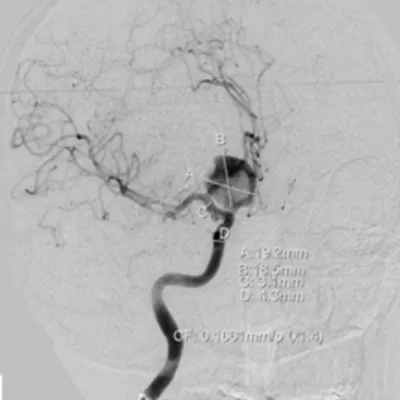
Patient K., born 1974, was admitted to the Center with clinical signs of subarachnoid hemorrhage on day 4 after onset of the illness, diagnosed by multislice computed tomography (MSCT) of the brain. Neurological status: Glasgow Coma Scale (GCS) – 14 points, cephalgic and meningeal syndromes. Seldinger cerebral subtraction angiography (CAG) revealed a giant aneurysm of the supraclinoid segment of the right internal carotid artery and the aneurysm rupture site (diverticulum) (Fig. 1).
Cerebral subtraction angiography: A – oblique frontal projection. Giant aneurysm of the supraclinoid segment of the right internal carotid artery. The aneurysm dimensions and parent artery diameters are shown; B – lateral projection. Late arterial phase: slowed blood flow in the aneurysm and the presence
of a diverticulum (indicated by the arrow)

A decision was made to perform endovascular occlusion of the aneurysm with microcoils using a stent-assisted technique. The FRED flow-diverting stent (Microvention – Terumo) was used for stent assistance. This endovascular treatment strategy was chosen to ensure a durable long-term angiographic result by preventing recanalization of the aneurysm in the long term. 2 hours before surgery, the patient received a loading dose of dual antiplatelet therapy (clopidogrel – 300 mg, acetylsalicylic acid – 300 mg). According to light transmission aggregometry, the patient was sensitive to dual antiplatelet therapy. The stages of surgery are shown in Fig. 2.
Further dual antiplatelet therapy was prescribed according to the standard regimen (clopidogrel – 75 mg/day, acetylsalicylic acid – 75 mg/day). The patient was discharged in satisfactory condition under the supervision of a neurologist at her place of residence, without any neurological deficit, on day 18 of the illness.
Cerebral subtraction angiography, oblique frontal projection. Stages of surgery: A – before the start of surgery; B, C – stages of microcoil implantation into the aneurysm and deployment of the flow-diverting stent in the lumen of the parent artery. The microcatheter jailing technique was used; D – reconstructive exclusion of a giant internal carotid artery aneurysm with stent assistance by a flow-diverting stent


