


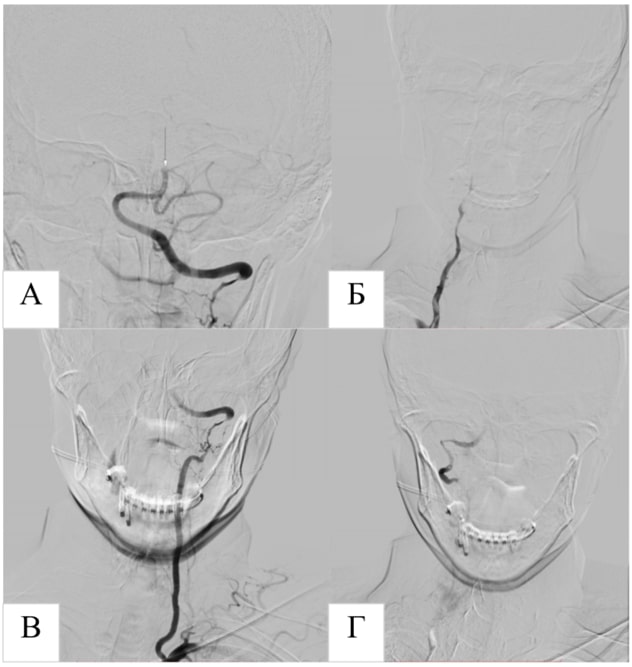
A – Thrombosis of the BA in the middle third (arrow); false lumen of the left vertebral artery in the V3 segment. (B) dissection of the V2 segment of the right VA. C – false lumen at the level of the left VA dissection. D – dissection of the V3 segment of the right VA.
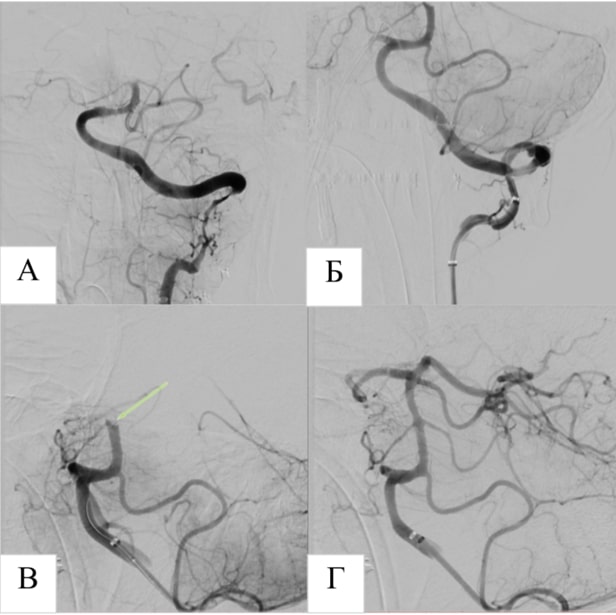
A – Thrombosis of the BA in the middle third , and false lumen of the left vertebral artery in the V3 segment. (B) true lumen at the level of the dissection of the V3 segment of the left VA. C – thrombectomy stage , BA thrombosis indicated by arrow A. D – control AG after reperfusion (eTICI – 2C.
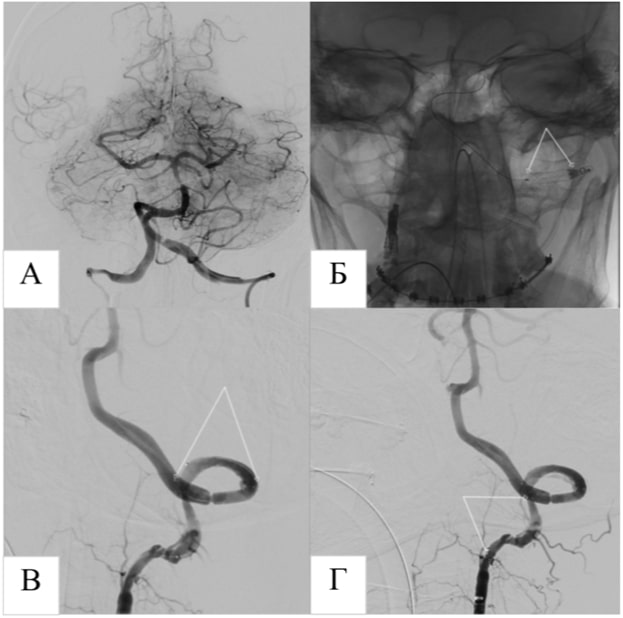
A – stages of stenting of the left VA. (B) implantation of a Resolute Onyx stent at the level of the VA dissection. C and D – implantation of Acclino Flex stents, indicated by arrows.
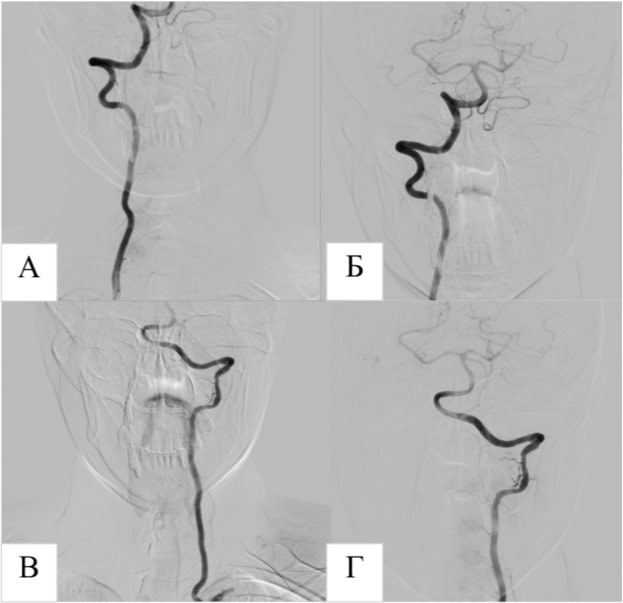
Follow-up angiography after 6 months – restored patency and normalized lumen of the right VA (A and B ) and the left VA (C and D) Patency of the stents in the V3 segments is preserved (C and D )
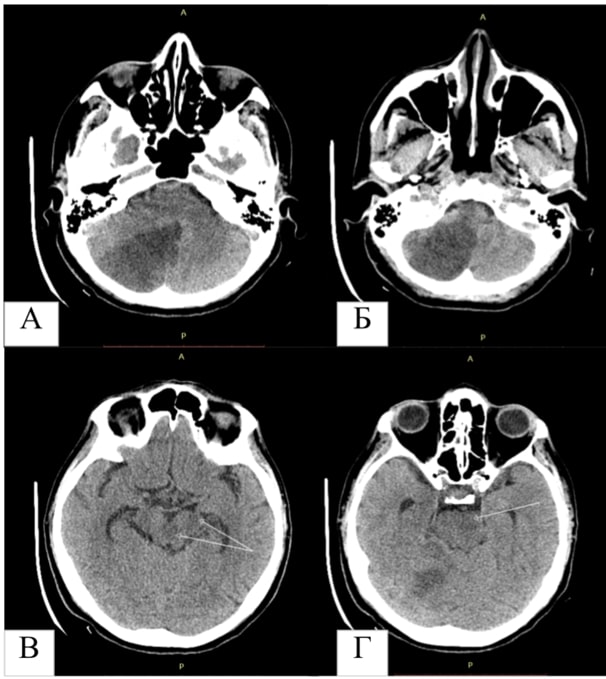
Brain MSCT at discharge – ischemic focus in the right cerebellar hemisphere (A and B ), the midbrain on the left (C) and the pons on the left (D).
Patient Kh, born 1973. From early July she noted discomfort and pain in the cervical region, which she attributed to local cooling from an air conditioner. Later, complaints of headaches, dizziness, unsteadiness when walking and episodes of increased blood pressure appeared. From 09.07.2024, complaints of nausea, repeated vomiting and impaired swallowing. On 10.07.2024 (at 2 a.m.) the above complaints increased. An ambulance was called. Brain MSCT (10.07.2024) – signs of an acute ischemic stroke in the right cerebellar hemisphere. On 11.07.2024 at 7:00 a.m. her condition deteriorated sharply – weakness in the right limbs, impaired speech and consciousness. She was admitted to the Center for examination and treatment.
Objective status on admission: Skin – flesh-colored. Neck veins – not distended, without pathological pulsation. Lungs – vesicular breathing, no wheezing or crepitation. Abdomen – soft, participates in breathing. Pulse in the peripheral arteries is symmetrical.
Neurological status on admission: On admission, her general condition was serious. GCS – 12 points. NIHSS- 18. Marked dysarthria, dysphagia, marked nystagmus. Deep right-sided hemiparesis (plegia in the arm).
On 11.07.2024, total selective cerebral angiography (CAG) was performed – thrombosis of the basilar artery in the middle third. Dissection of the V3-V4 segments of the left vertebral artery (VA), dissection of the V2-V3 segments of the right VA. There were no complications.
On 11.07.2024, surgery was performed: endovascular thrombectomy from the basilar artery. Reperfusion eTICI – 2c. Angioplasty with stenting of the dissection of the V3-V4 segments of the left vertebral artery ( implantation of three stents: 1. Resolute 4.0×12.0 mm. 2. Two Acclino 5.5X25 mm stents.). There were no complications.
Brain MSCT (12.07.2024) – acute ischemic stroke in the VBT (right cerebellar hemisphere), in the pons and the midbrain on the left (pc ASPECTS 5).
Chest MSCT (12.07.2024) – bilateral lower lobe pneumonia. A nasogastric tube was placed.
12.07.2024 bronchoscopy with the FEES swallowing test. Grade III dysphagia. Diffuse moderate purulent bronchitis.
14.07.2024 – percutaneous endoscopic gastrostomy (PEG). There were no complications. Follow-up bronchoscopy (with sputum sampling for bacterial culture).
Brain MSCT (17.07.2024) – acute ischemic stroke in the VBT (right cerebellar hemisphere), in the pons and the midbrain on the left (pc ASPECTS 5). No changes compared with the examination of 12.07.2024.
With the therapy provided, there was positive dynamics in neurological status. GCS – 15. Strength and range of movement in the right leg were restored; in the right arm – mild, close to moderate paresis. Significant regression of dysarthria, regression of nystagmus. Mild central-type paresis of the left VII cranial nerve persists.
For further treatment and rehabilitation, she was transferred to the Feofaniya Clinical Hospital.
At the follow-up examination, mRS – 1


